What to Expect in Your First Therapy Session
Starting therapy can feel like a big step, especially when you don’t know what happens in the room. Here’s how it works at Serenity Harbour, from the free consultation to the end of your first session.
IN SHORT
It starts with a free 15-minute consult, so you can see whether the fit feels right before you book.
You’ll read and sign a client agreement before your first session. You can read it now in our Resources library.
The first session is a conversation at your pace. You don’t need the right words, and you decide what to share.
Many people think about therapy for months before they reach out. Some aren’t sure their problem is “big enough.” Others worry about being judged or about having to tell their whole life story in one hour. Knowing what actually happens can take a lot of that pressure off.
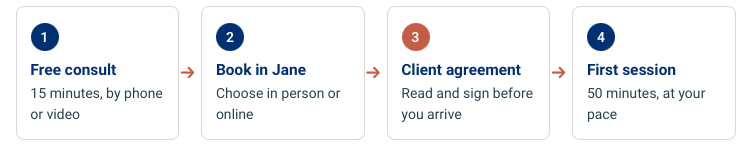
Step by step: from first contact to first session
Before you begin: the free consult
Most people start with a free 15-minute consult, by phone or video. You can briefly share what’s bringing you in, ask how I work, and see whether we’re a good fit. There’s no pressure to book anything afterwards.
If you decide to go ahead, you’ll book your first session online through Jane, our secure booking system. Sessions are available in person at our Burlington and Mississauga offices, or online anywhere in Ontario, in English or Arabic.
The paperwork: your client agreement
Before your first session, you’ll receive an intake form and client agreement to complete in Jane. The agreement explains, in writing, how therapy works here, including:
Confidentiality and its limits. What you share stays private, with a few legal exceptions, such as a serious risk of harm to you or someone else, or a child who may be at risk.
Fees, receipts and cancellations. What sessions cost and how much notice to give if you need to reschedule.
Online sessions. How video sessions work and how we protect your privacy.
Your records. How we store your information and who can see it.
You’re welcome to read it in advance. You can find it in our Resources library, along with other helpful handouts. If anything is unclear, we’ll go over it together at the start of your first session.
What happens in the first session
Your first session is a conversation, not a test. Here’s roughly what we’ll cover:
Getting settled. We'll review confidentiality, answer any questions about the agreement, and talk about how sessions work.
What brings you here now. You share what’s been happening and why you decided to reach out now, in your own words.
A little background. I’ll ask some general questions about your life: relationships, work, sleep, health, and what has helped you through hard times before. You choose how much to say.
How you’re doing right now. I ask everyone a few questions about safety and wellbeing. It’s a standard part of a first session, not a sign that something is wrong.
What you hope for. We talk about what you’d like to change and start shaping goals together.
Next steps. I’ll share my first thoughts on how we might work together, and you can ask anything you like.
Sessions are 50 minutes. You can find current rates on our Fees & Insurance page.
Wondering whether therapy could help? See how individual counselling works at Serenity Harbour, what it can help with, and answers to common questions.
Do I have to talk about everything?
No. You set the pace. Many people come in carrying something painful, and it’s okay to say “I’m not ready to talk about that yet.” Part of my job is to help therapy feel safe enough before we go anywhere difficult. This matters especially if you’ve been through hard experiences in the past; our trauma therapy page explains how we put safety and pacing first.
What happens after the first session
Over the next few sessions, we get to know the patterns behind what you’re facing and start building tools that help between sessions. Many people begin with weekly or every-other-week sessions and space them out as things improve. We’ll check in regularly about how it’s going and whether the approach feels right for you.
Depending on what you’re working on, that might draw on attachment-focused and Emotionally Focused work, IFS-informed parts work, CBT skills, or body-based grounding. If you’re coming with a partner, read what happens in your first couples session instead.
How to prepare
You don’t need to do anything special. If it helps, you might think about:
A few questions
What made me decide to reach out now?
When is this hardest? When is it a little easier?
What would tell me, a few months from now, that therapy had helped?
A few practical things
Read the client agreement and note any questions.
For online sessions, find a private spot with a good connection.
Check your extended health benefits for psychotherapy coverage.
Common worries
“What if I cry, or can’t find the words?”
Both happen often, and both are okay. Tears and silence are part of the work, not interruptions.
“What if it doesn’t feel like a good fit?”
Fit matters. You’re always welcome to tell me what is or isn’t working, and if another therapist or approach would suit you better, I’ll help you find one.
“Is online therapy as good as in person?”
Many people find online sessions work well, especially if they have busy schedules or long drives. You can choose what feels most comfortable and switch later if you like.
A note on safety. Therapy isn’t an emergency service. If you are feeling overwhelmed, hopeless or unsafe, please don’t wait for an appointment. In an emergency, call 911 or go to your nearest emergency department; for crisis support, call or text 988.
Michael Wassef, MDiv, BEng, Registered Psychotherapist, offers individual counselling, trauma therapy and couples therapy in Burlington, Hamilton, Oakville and Mississauga, and online across Ontario, in English and Arabic.
This article is general information, not therapy or medical advice, and doesn’t describe any specific client.